Outsmart Your Cat’s Inner Shredder: Troubleshoot Clawing Chaos
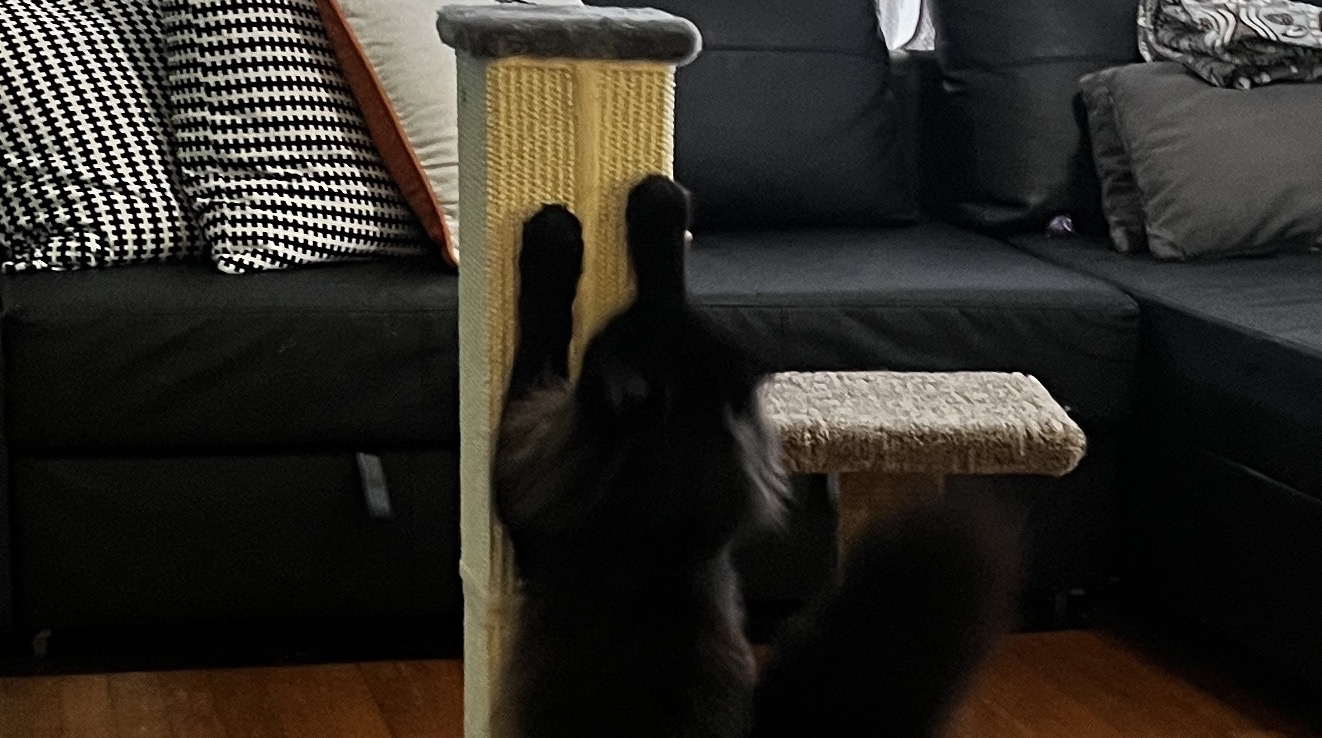
Espresso uses the scratching post next to the couch.
Source: J. Pallanich
Just because you have a cat doesn’t mean your couch will become a pincushion.
Yes, kitty’s got claws, and they need to put them in something, but you can offer more appealing scratching surfaces that will help keep those claws out of your couch.
It’s no secret that cats need to scratch on things. It’s an instinctual behavior, and doing so serves multiple purposes:
It promotes nail health.
It allows them to lay down scent – a form of marking.
It provides a visual mark of their presence.
It gives a good stretch, which feels good and releases endorphins.
It allows them to express emotions like excitement or work off some stress.
It can just be enjoyable.
Cats tend to have preferred scratching orientations, surfaces and locations.
If your cat is scratching things in your house, consider what and where and how they’re scratching so the alternative scratching surface you provide will be more attractive to them.
Orientations
Typical orientations are vertical, horizontal and diagonal or angled scratching surfaces, and each offers a different kind of stretch.
Vertical scratchers should be tall enough to provide a cat with a good deep back stretch – that means it needs to be taller than the cat’s body length when standing on their hind legs.
Horizontal surfaces offer a different kind of good stretch. Many cats enjoy horizontal scratching, and older cats may prefer horizontal surfaces over vertical surfaces, possibly because it causes less stress on joints.
Angled or diagonal surfaces split the difference between horizontal and vertical, offering a nice stretch with less strain on joints. Diagonal surfaces can be especially appealing if they also serve as a ramp to an elevated surface.
No matter which orientation, the scratcher should be wider than the cat’s body for maximum scratching satisfaction and comfort.
Surfaces
Different textures give cats different experiences while scratching. Some cats may find sisal the only thing they enjoy scratching on while others may prefer a combination of surfaces. Typical commercially available scratching surfaces include:
Sisal: Durable and commonly found on commercial scratchers, it mimics the texture of tree bark.
Cardboard: Affordable but needs frequent replacement.
Carpet: Shreds easily but can be satisfying.
Additionally, outside cats are all about scratching on trees. If your cat is lucky enough to have a catio, consider adding a couple of cut tree segments. It will allow your cat to leave visual and scent marks on tree bark. That could get messy inside, though!
Locations
Cats tend to scratch where they spend their time. They don’t save up their nail maintenance for a bi-weekly trip to the nail salon. They are constantly caring for their nail health, needing to leave scent or visual marks, scratching to work through emotions, or wanting a good stretch.

Espresso uses this cardboard scratcher both for scratching and lounging!
Source: J. Pallanich
Ideally, your cat will have a variety of scratching options in every room they spend time in. That way, they have scratching targets that are acceptable to humans whenever the urge strikes.
Couches are often a target for scratching. Why? Possibly:
Because humans spend a lot of time there, so the cat may also spend a lot of time in that area.
Typically tall enough to provide a satisfying vertical stretch – or at least a better vertical stretch than they can get from a shorter scratcher.
Because of its stability. Some scratchers may wobble as a cat scratches.
Because they enjoy the scratching surface, in which case you may want to provide a similar surface away from the couch to encourage scratching there.
A recent tally of scratching surfaces in my house revealed:
Sisal, short vertical board, kitchen, rarely used
Sisal, diagonal on cat hammock, kitchen, rarely used
Rug, horizontal, kitchen, used frequently
Cardboard, horizontal, kitchen/dining room, used frequently
Cardboard, vertical, dining room, rarely used
Sisal (vertical) and carpet (horizontal), cat tree, living room, both surfaces used frequently
Sisal, tall vertical post, living room, used frequently
Cardboard, horizontal, living room between couch and front door, used frequently
Sisal & carpet, vertical/horizontal/diagonal, very large cat tree in living room, rarely used for scratching
Cardboard, horizontal, interactive scratcher/ball chaser toy, living room, used frequently
Cardboard, curved, living room, rarely used
Sisal, vertical, couch protector, living room, rarely used
Cat scratcher buffet box (Sisal, artificial grass, canvas, rug, carpet, burlap, vinyl), horizontal and vertical, living room, used occasionally
Cardboard, horizontal, bedroom, used frequently
If your cat spends time watching out the window, you may want to make sure there are scratching surfaces nearby in case your cat decides they need to do a bit of scent or visual marking or needs to work out some emotions after seeing neighbor cats outside.
Pro tip: You can mount cardboard scratchers on walls or doors by using 3M’s CommandTM Strips, allowing you to tailor the vertical height of the scratcher to your cat’s needs.
Scratcher types
Commercially available scratchers for cats come in many types.

Cat hammock with built-in scratcher. This scratching surface is built into cat furniture. Espresso uses the cat hammock a lot, but I’ve never seen him use the angled scratching surface.
Source: J. Pallanich
Posts: Vertical scratching posts, especially those that are 32 inches or taller, are great for scratching, stretching and climbing. Typically sisal or carpet.
Pads: Usually horizontal, such as cardboard scratchers.
Ramps: Provide that angled or diagonal surface. As a bonus, these ramps can help a cat reach or leave an elevated surface.
Cat trees, hammocks and similar furniture: Multipurpose items that typically incorporate scratching surfaces with elevated lounging locations.
Enclosed: Typically a cardboard scratcher box with a hiding spot for cats.
Interactive: Toys incorporating scratching surfaces, such as a ball chaser with a scratching surface interior.
Failure to scratch
Just putting a scratcher out for your cat may not be enough. They may need a bit of encouragement to interact with the new thing in their environment. Play, treats and catnip can all help.
For example, I used play to encourage Espresso to use his new 32-inch scratching post.
When the tall scratching post arrived, I initially put it in the living room near the shorter cat tree, thinking my cat would just know he could scratch it. Two days later, I was pretty sure he hadn’t done anything but sniff it.
I pulled out his favorite wand toy and we played a bit before I dangled the toy near the top of the post and waited until he leapt up to capture it. I immediately praised him and gave him a treat for jumping up on the post. We repeated that a few times during our play session. After, I praised and reinforced every time he interacted with it. It was quickly clear he loved the thing, and I stopped needing to reinforce his interactions.
Troubleshooting
Is your cat scratching up your home furnishings? Time to scrutinize the type, style and placement of scratching surfaces in your house.
Is it carpet? Try a horizontal carpet scratcher. Is it the back of the couch or your drapes? Try a stable vertical scratching post, ideally located right next to the back of the couch.
If you can, offer a cat scratcher buffet to allow your cat to pick where and how they like scratching. Remember, for a cat, scratch is life!
As you add scratchers, consider covering the surfaces you don’t want scratched to make them less satisfying. At the same time, encourage use of the desired scratching surface by offering treats when the cat uses them.
What kind of scratcher can you add to your cat’s life?
Stay pawsome.